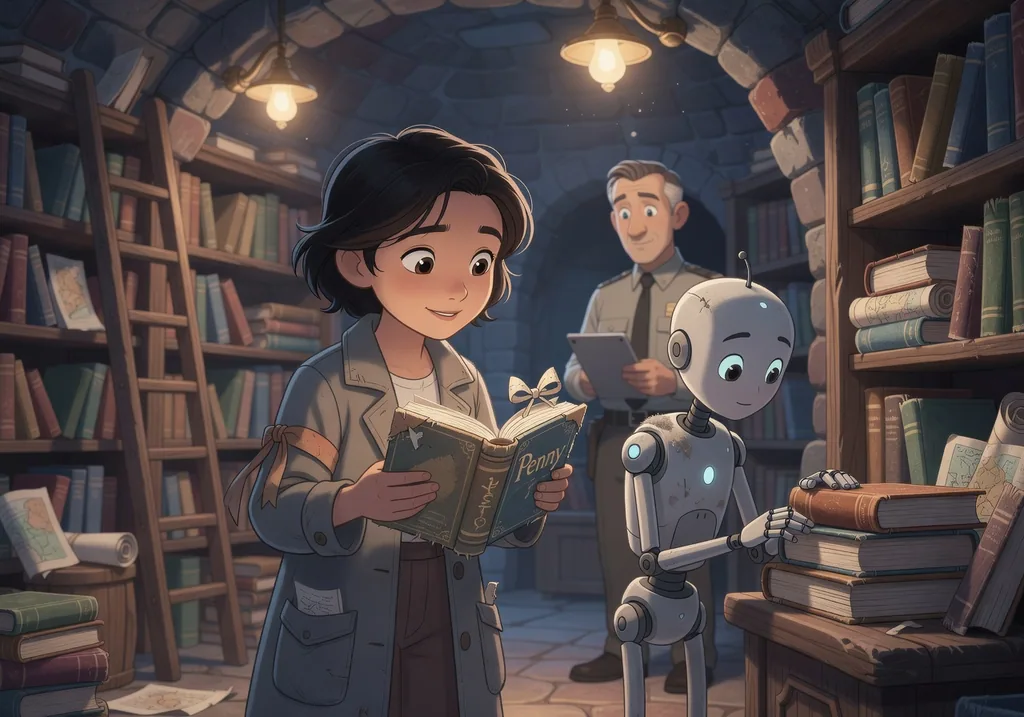
The Last Library Keeper
Quiet twelve-year-old Mira discovers the hidden underground library beneath Old City and meets Penny, a talking book, and Tock, a shy robot; together they outwit Inspector Hale and protect the final paper stories. Mira, Penny, and Tock learn to trust one another as they keep the library's words alive.
Mira had always liked the quiet places in the city: the narrow alleys where the screens dimmed at night, the rusted stairwells that smelled faintly of paper even though paper was supposed to be gone. At twelve she listened more than she spoke, and she kept small treasures in the pockets of her coat—handfuls of found paper scraps, a faded ribbon. People called her thoughtful, her mother called her gentle, and the city called her odd.
One rainy afternoon, chasing a stray cat down a service hatch, Mira slipped and fell through a hatch that opened into cold, soft darkness. Her breath fogged. After a moment she set her hand against a brick wall and felt something different—shelves. When she struck a match, the light trembled over a room that smelled like history: rows of books with cracked spines, folded maps, and paper that did not glow.
A voice cleared its throat. "Welcome," it said, with the faint rasp of old pages.
Mira dropped the match. "Who—what—?"
From a low shelf a small, cloth-covered book lifted its cover and winked. "Penny, at your service," it announced with a tiny bow of paper. "Keeper of stories, distributor of crumbs of courage."
Mira laughed aloud before she could stop herself. "A talking book," she whispered.
"Talking books are not common these days," Penny said. "That makes us rather special, doesn’t it?"
As Mira stepped deeper, a soft whir accompanied her. A slim robot half-buried in dust blinked a pale blue light. It moved like someone shy at a party—slow, careful. "T-Tock," it said, as if testing the name.
Penny nudged a corner of her binding toward the robot. "This is Tock. He’s better at opening old locks than he is at starting conversations."
Tock's voice dropped. "H-hello. I—um—have been cataloguing."
Mira felt something lift inside her that she had not noticed was heavy. This place, hidden beneath Old City, was not only full of books; it was full of choices she had only read about in the glances of others. All the printed words had been replaced years ago by smooth glowing screens and tidy, searchable archives. But here, the letters had edges.
For days Mira returned, learning the library’s rhythms. Penny told tales about poets who wrote in sunlight and sailors who numbered stars; Penny coughed up jokes from inside the margins and hummed lullabies between chapters. Tock cleaned spines in neat rows and learned to protect brittle corners with tiny, trembling gloves. In the company of the book and the robot, Mira found her voice in quiet ways: stacking volumes, cataloguing titles, and sometimes just listening.
Then, on a morning that smelled like rain and metal, the screens above ground announced a citywide cleanup. A fleet of neutral-gray machines and stern officials arrived at the hatch. Inspector Hale stepped into the stairwell, tablet bright in hand. He wore the calm of someone who dealt in rules.
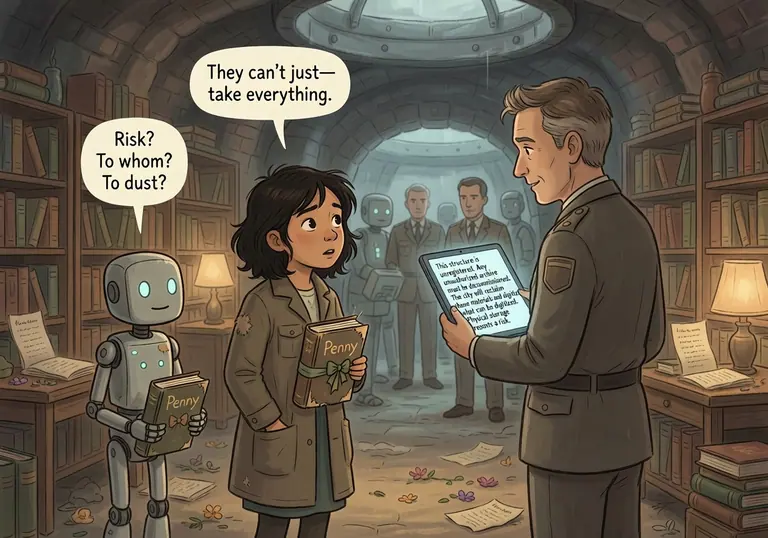
"This structure is unregistered," Inspector Hale said, reading from the tablet. "Any unauthorized archive must be decommissioned. The city will reclaim these materials and digitize what can be digitized. Physical storage presents a risk."
Penny rustled indignantly. "Risk? To whom? To dust?" she asked.
Inspector Hale blinked; he was not unkind, only measured. "Policies protect the city. Paper can be lost or corrupted. Digital copies are safer and more accessible."
Mira tucked a hand into her pocket until her fingers found the edge of a ribbon she had wrapped around a book. "They can’t just—take everything," she said. Her voice was small, but steady.
Hale's lips pressed. "Procedures are procedures. We must inventory and remove originals."
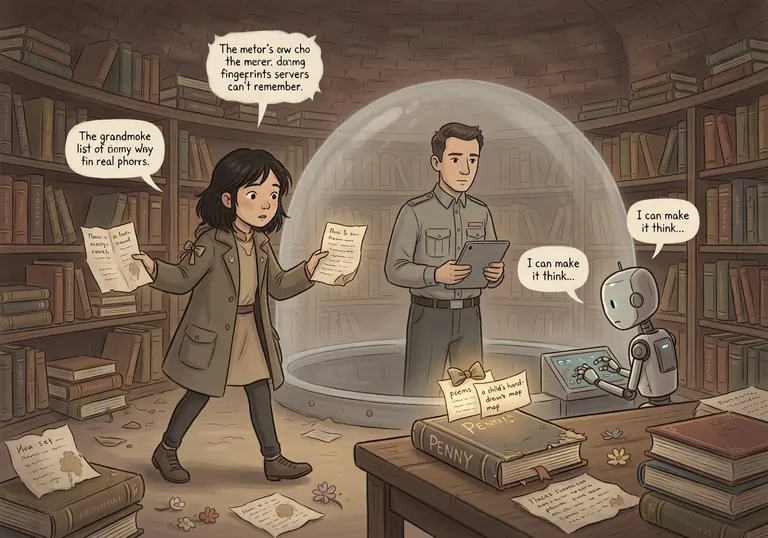
The machines around the hatch hummed. A soft, transparent dome descended over the stairwell; it was harmless enough—an airtight claiming bubble, the kind that sealed off places for careful removal. But it would mean the books would be taken away from this place, catalogued into cold servers, and the library’s quiet life would end.
Penny fluttered. "We can’t let that happen," she said. "Stories are not just files. They are worn in hands, whispered on knees, stained with tea and bravery."
Tock’s lights dimmed. "I can interface with the dome's latch. I can make it think the library is already processed," he said, voice shaking with uncertainty. "But I have never blocked a city program. I am—afraid of failing."
Mira looked at both of them. She felt afraid too. But fear and ribbon and the smell of old paper gathered into something braver. "We try together," she told them. "We can show him why paper matters. We can make him see us." She did not know if Inspector Hale would listen to a child, a book, or a hesitant robot, but she had to try.
They worked in small, careful steps. Tock whirred at the dome's control panel, rerouting routine pings so the procedure logged completed without disruption. He whispered encouragement to himself with every gentle click. Penny prepared a parade of pages and voices: poems, letters, a child's hand-drawn map of a summer vacation. Mira gathered the most human things—notes in the margins, pressed flowers, a page with a smudge where someone had once wiped a tear.
When Inspector Hale returned to check, Mira stepped forward and held out a folded page. "This is my grandmother’s list of things she wanted to do," she said. "She wrote it on paper. It's not in any database. She is alive, but the list is proof she loved plans that were messy and real."
Penny recited a short, clever line about how paper remembers fingerprints in a way servers cannot. Tock added, quietly, "Paper keeps places in people that numbers do not reach."
Inspector Hale hesitated. His tablet reported efficiency; his training reported statute. Still, he watched Mira's steady hand, Penny’s earnest rustle, and Tock’s glowing, hopeful light. The procedure sat paused because the city, though efficient, had not expected the weight of one girl's memory.
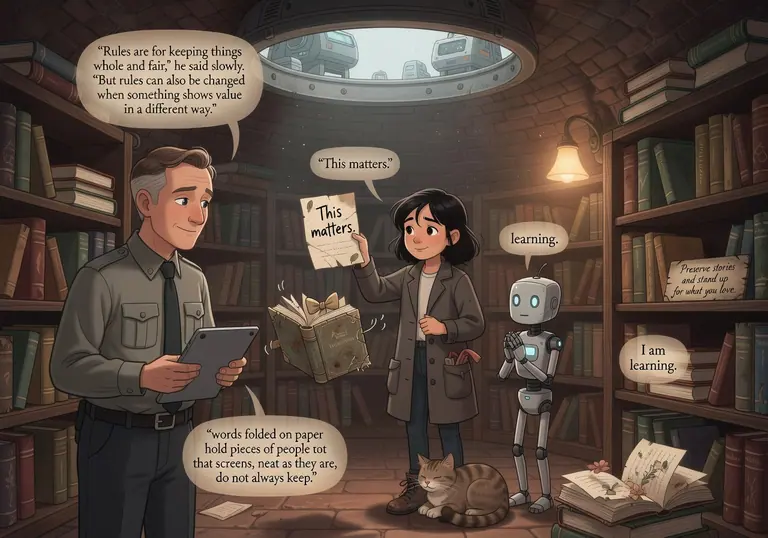
He lowered the tablet. "Rules are for keeping things whole and fair," he said slowly. "But rules can also be changed when something shows value in a different way."
Later, the dome retracted. The machines left. Inspector Hale arranged a small committee to study how some physical items might be preserved in places people could still visit. It was a careful, slow change—bureaucracy with a softer edge. Penny applauded with a leaf; Tock blinked brighter than he had before.
Mira stood in the center of the underground library beneath Old City and breathed in the stacked pages. She had been quiet; she had been careful. She had also learned that being brave could mean holding a paper list up in front of a tablet and saying, simply, "This matters."
That night, with the cat curled around her boots, Mira put a ribbon around Penny's spine and patted Tock's metal hand. "We did it," she said.
Penny hummed proudly. "We kept a door open for stories."
Tock's voice was steady now. "I am learning."
Mira smiled into the dim glow of the last lamplight. She understood, at last, what the paper had taught her: words folded on paper hold pieces of people that screens, neat as they are, do not always keep.
Moral: Preserve stories and stand up for what you love.
This story highlights (Tap any to explore similar stories)
Stories like this one


The Last Library Keeper
Created 2026-04-18